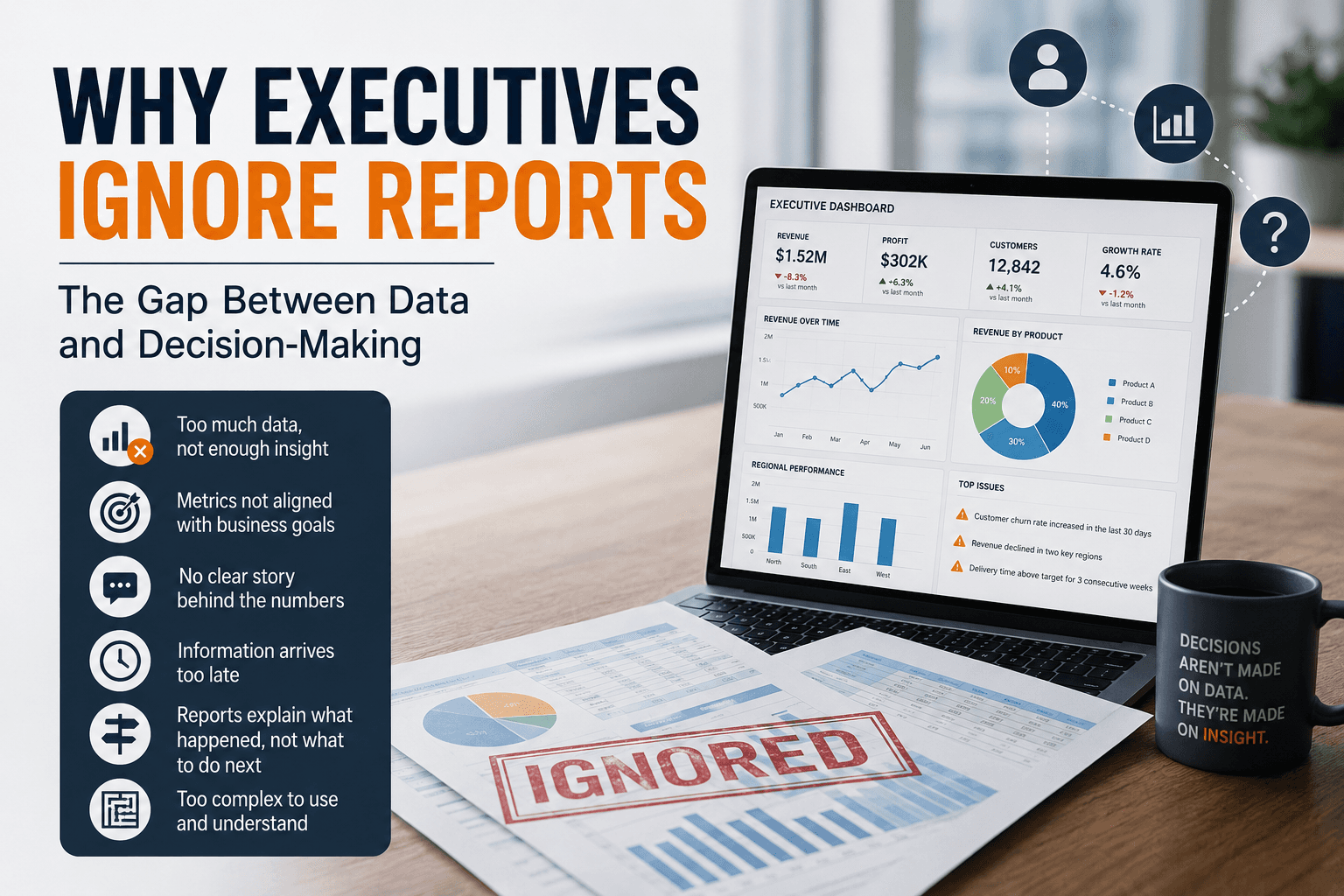
Organizations spend significant time and money building reports and dashboards. Yet many executives rarely use them for decision-making.
The problem is often not the quality of the report. It's the gap between information and action.
Here are some common reasons executives ignore reports:
1. Too Much Data, Not Enough Insight
Many reports focus on presenting numbers rather than explaining what they mean.
Executives don't need to know every metric. They need to understand:
What changed?
Why did it change?
What should we do next?
A report that answers these questions is far more valuable than one that simply displays data.
2. Metrics Are Not Aligned with Business Goals
A report may contain dozens of KPIs, but if those KPIs are not linked to strategic objectives, they become noise.
For example, tracking website visits is less useful if the business objective is increasing customer retention.
The most effective reports connect metrics directly to business outcomes.
3. No Clear Story
Data without context is difficult to interpret.
A report should tell a story:
What was expected?
What actually happened?
What factors contributed to the result?
Storytelling transforms data into something decision-makers can quickly understand.
4. Information Arrives Too Late
A perfectly designed report loses value if it reaches decision-makers after the opportunity to act has passed.
Timeliness is often more important than perfection.
Executives need information when decisions are being made, not weeks later.
5. Reports Focus on Monitoring Instead of Action
Many reports answer "What happened?"
Few answer:
What should we investigate?
What risks should we address?
What opportunities should we pursue?
The closer a report gets to supporting action, the more likely it is to be used.
6. Complexity Creates Friction
When users need extensive training to understand a dashboard, adoption suffers.
Good reporting simplifies complexity.
The best reports allow executives to identify key issues within minutes, not hours.
Final Thoughts
Executives do not ignore reports because they dislike data.
They ignore reports that fail to help them make decisions.
The goal of reporting is not to display information. The goal is to enable action.
The most valuable report is not the one with the most charts, filters, or metrics. It is the one that helps a business make better decisions faster.